
Breaking News
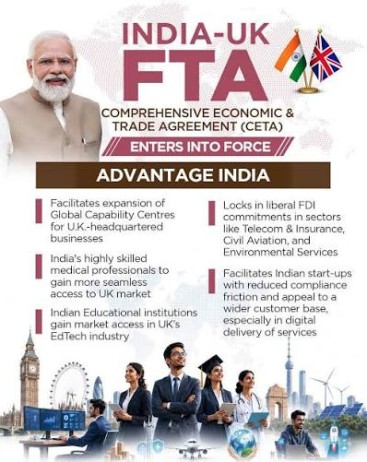
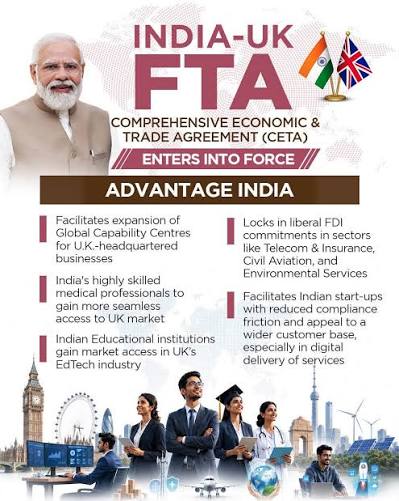
The India–United Kingdom Comprehensive Economic and Trade Agreement (CETA), along with the Agreement on Social Security, also known as the Double Contribution Convention (DCC), formally entered into force today, marking a major milestone in the economic partnership between the two countries.
A formal inauguration event to mark the entry into force of CETA was held at Vanijya Bhawan, New Delhi. The function was attended by Her Excellency Ms. Lindy Cameron, British High Commissioner to India, Commerce Secretary Shri Rajesh Agrawal, Director General of Foreign Trade, representatives of Industry Export Promotion Councils, industry associations and several exporters.
In a post on X, Union Minister of Commerce and Industry Shri Piyush Goyal said that the entry into force of the India–UK Comprehensive Economic and Trade Agreement (CETA) and the Agreement on Social Security marks a defining milestone in India–UK relations. Under the leadership of Prime Minister Shri Narendra Modi, the Agreements have come into force, providing zero-duty market access for nearly 99 per cent of India’s exports and covering almost 100 per cent of trade value.
The Minister noted that the Agreement creates unprecedented opportunities for sectors including textiles, leather, gems and jewellery, engineering goods, marine products, chemicals and processed foods, while benefiting MSMEs, farmers and manufacturers. He further observed that the Agreement opens new opportunities for India’s IT, professional, financial, education and business services sectors and expands mobility for Indian talent.
Shri Goyal underscored that the Agreement on Social Security strengthens the partnership by exempting Indian professionals on temporary assignments in the United Kingdom from double social security contributions for up to five years, thereby enhancing the global competitiveness of India’s workforce. He also expressed appreciation to his UK counterpart and both negotiating teams for their commitment in bringing the transformational agreement to fruition and reaffirmed the shared commitment of both countries to building a resilient, innovation-driven partnership that promotes growth, investment and shared prosperity.
Addressing the gathering, Commerce Secretary Shri Rajesh Agrawal described the entry into force of CETA as a pivotal milestone in the deepening India–UK relationship and one of the most significant achievements in the journey of the Department of Commerce. He stated that the Agreement is fully aligned with the vision of Prime Minister Shri Narendra Modi for strengthening the India–UK partnership and acknowledged the leadership of Union Commerce and Industry Minister Shri Piyush Goyal in steering the negotiations to a successful conclusion.
The Commerce Secretary highlighted the scale and complexity of the negotiations, noting that more than 800 technical sessions were conducted across 14 formal rounds of negotiations before the Agreement was finalised. He commended the negotiating teams on both sides for their sustained efforts over several years in achieving the outcome.
Shri Agrawal observed that the Agreement is between two major and complementary economies and goes beyond India’s previous free trade agreement precedents in terms of both width and depth of coverage. He stated that while the Agreement creates substantial market access opportunities in goods trade, it also provides significant gains in services trade. Given that services account for more than 50 per cent of India’s GDP and over 70 per cent of the United Kingdom’s GDP, he noted that the commitments and predictability offered through the Agreement would provide a strong impetus to bilateral services trade in the years ahead.
Emphasising the importance of implementation, Shri Agrawal stated that the real success of the Agreement would be measured by its impact on the lives of people in both countries through the creation of jobs, livelihoods and economic opportunities. He called upon industry stakeholders to convert the opportunities created by the Agreement into tangible outcomes and assured that the Department of Commerce would work closely with Export Promotion Councils and industry clusters across the country to communicate the benefits of the Agreement at the sectoral, product and cluster levels.
The Commerce Secretary informed that the decision to operationalise the Agreement on 15 July 2026 was taken by the leaders of both countries during their meeting on the sidelines of the G7 Summit in France thirty days earlier. He stated that all pending issues had been resolved within the stipulated timeline and that all requisite notifications had been issued by both sides. Necessary trade facilitation measures, including arrangements relating to Rules of Origin certification and customs preparedness, had also been put in place to ensure that stakeholders could begin availing the benefits of the Agreement from the very first day.
He noted that more than USD 140 million worth of goods were being exported to the United Kingdom on the first day of implementation under the India–UK CETA. He expressed confidence that sustained utilisation of the Agreement would strengthen India–UK trade and encourage the pursuit of other trade initiatives currently under consideration.
To commemorate the entry into force of the Agreement, events were held across the country to flag off the first export consignments under the India–UK CETA preferential tariff regime. During the day, over 50 export consignments valued at more than USD 140 million were flagged off from more than 20 ports, airports, Inland Container Depots (ICDs), Special Economic Zones (SEZs) and factories across India. The consignments covered a wide range of products including electronics, pharmaceuticals and gems and jewellery, and were dispatched from locations including the seaports of Mundra, Nhava Sheva and Chennai, as well as air cargo complexes at Mumbai (Sahar), Kolkata and Hyderabad.
Speaking on the occasion, Her Excellency Ms. Lindy Cameron, British High Commissioner to India, described the entry into force of the Agreement as a historic milestone and a testament to the elevated UK–India bilateral relationship.
Highlighting the strength of bilateral ties, she noted that India was the United Kingdom’s eleventh-largest trading partner in 2025, with bilateral trade approaching £48 billion annually. She also observed that the investment relationship between the two countries supports more than 700,000 jobs.
Ms. Cameron stated that the Agreement provides a framework that will enable businesses in both countries to trade more, invest more, innovate more and grow together. She described it as a decisive step towards a broader, more ambitious and future-focused partnership.
Referring to its long-term economic impact, she noted that the Agreement is expected to increase bilateral trade by over £25 billion annually over the long term and contribute nearly £5 billion annually to both UK GDP and Indian GDP. She stated that the Agreement would make trade simpler, quicker and more cost-effective for businesses in both countries.
She further observed that the Agreement would provide Indian businesses duty-free access on around 99 per cent of tariff lines covering nearly all Indian exports to the UK, while UK businesses would benefit from tariff reductions or eliminations on 90 per cent of tariff lines covering 92 per cent of current UK exports to India.
The High Commissioner highlighted that the Agreement extends beyond goods trade and strengthens cooperation in customs, digital trade, financial services, telecommunications, intellectual property, professional services, transparency and regulation. She noted that the Agreement would create significant opportunities across sectors including advanced manufacturing, food and drink, life sciences, energy, consumer goods, textiles, apparel, engineering goods, marine products and chemicals.
She also emphasised the benefits for small and medium enterprises and consumers, stating that the Agreement would help SMEs expand their reach while offering consumers greater choice, stronger competition and better value.
Noting that the Agreement had now moved from negotiation and signature to implementation, Ms. Cameron observed that goods were already moving between the two countries under the new framework and stressed that successful implementation would be critical in ensuring that businesses, workers and consumers realise its full benefits.
As part of the entry into force of CETA, the first Certificates of Origin under the Agreement were distributed to exporters. The certificates were issued through the eCoO 2.0 platform on a self-certification basis. The digital, self-certified issuance of Certificates of Origin on Day One marks a significant step towards reducing compliance burdens and transaction costs, particularly for MSMEs.
Representatives of industry associations, Export Promotion Councils and exporters welcomed the entry into force of the Agreement and noted that duty-free access, coupled with simplified certification procedures and business-friendly Rules of Origin, would significantly enhance the competitiveness of Indian products in the UK market.
Industry representatives expressed confidence that the Agreement would contribute meaningfully to the vision of Viksit Bharat by providing Indian goods with enhanced access to one of the world’s most advanced markets. They noted that the Agreement would place Indian exporters on a level playing field vis-à-vis competitors from other countries and elevate the economic partnership between India and the United Kingdom.
Industry leaders further highlighted that by boosting labour-intensive sectors, the Agreement would create new opportunities for women entrepreneurs, MSMEs, youth and students, thereby generating quality employment and supporting inclusive growth.
In Mumbai, the Government of Maharashtra organised a ceremonial inauguration of the India–UK CETA in the presence of Chief Minister of Maharashtra Shri Devendra Fadnavis. To mark the commencement of preferential trade under the Agreement, the Chief Minister of Maharashtra and the Deputy High Commissioner of the United Kingdom ceremonially exchanged cargo placed on trolleys containing curated boxes of products representing bilateral trade between India and the United Kingdom.
***
Abhishek Dayal/ Abhijith Narayanan/ Ishita Biswas